Attention is an indicator of good cognitive health and a clinical marker of the early stages of vascular dementia. Computerised attention span training demonstrates significant improvements but with high interindividual variability. With the use of Artificial Intelligence (AI), the project aims to show in elderly people or people with early-stage vascular dementia that customised training makes computerised attention training effective for all.
This project is coordinated by the FLOWERS team featuring the University of Bordeaux INRIA Centre (French National Institute for Research in Digital Science and Technology) and PARISTECH’s ENSTA multidisciplinary engineering school, headed up by Marion PECH, PhD. Postdoctoral student.
This interdisciplinary project combines both AI skills and clinical skills, providing cognitive intervention for neurotypical elderly people or people with minor vascular cognitive disorders.
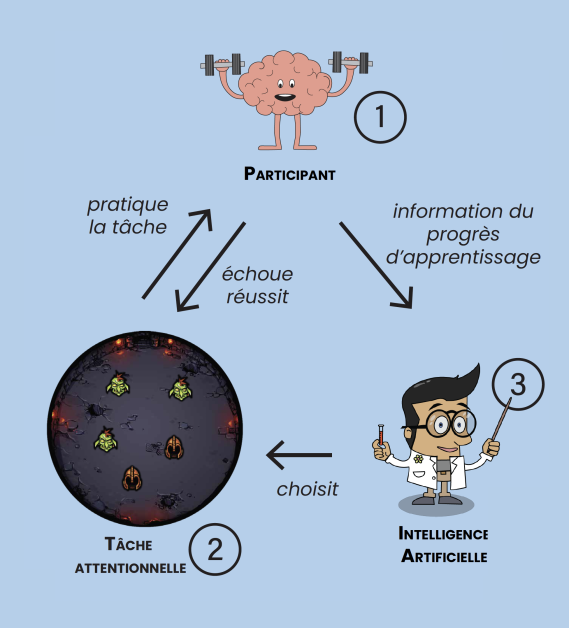
The aim is to find out whether AI techniques, and particularly customisation algorithms, can optimise the number of responders to an attention training programme.
Dementia is caused by a mixture of neurodegenerative lesions and cerebrovascular diseases (CVD) that include vascular lesions that are “hidden” but detectable with neuroimaging upstream from clinical events and are associated with increased stroke risk.
In France, it is estimated that more than 5 million people aged over 65 suffer from CVD and could benefit from attention training to prevent or delay strokes and major neurocognitive disorders such as dementia.
The project proposes for the first time to take up the challenge of customising attention training for elderly subjects using Intelligent Tutoring Systems (ITS), in a cognitive intervention clinical pilot study.